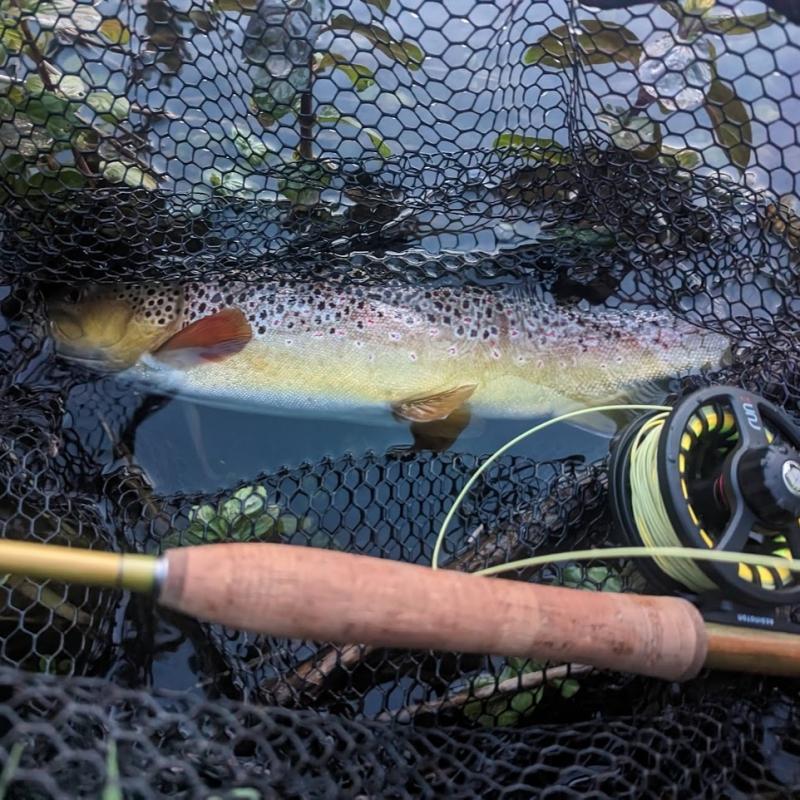

The valley has turned white with hawthorn blossom. Wild mint scent lifts from the margins as you move through the bankside, and the limestone stream runs clear through bends, riffles and deep, quiet slacks. This is the perfect setting for mayfly fishing when the season arrives.
Mayfly time is often sold as the great red-letter moment of the trout season. Sometimes it is. Two nights ago, I had six or seven beautiful wild browns and rainbows to the surface. The next day, with a chilly wind and flat light, it was a very different story.
That is the truth of mayfly fishing. It can be magical, but it is rarely easy. Success is not just about tying on a big mayfly pattern. It is about reading water, managing drag, staying low and knowing when the trout are ready to commit.
1. Fish the Shallows Other Anglers Walk Past
As the season moves on, trout often leave the deeper winter holding water and push into faster runs. On limestone streams, this can mean fish sitting in surprisingly shallow water.
Do not ignore the riffles. A wild rainbow or brown trout can sit in two or three inches of water if there is cover, current and food. Look for the tongue of faster water running through a shallow glide, or the very edge of streamy water where a trout can hold with little effort.
If there is enough water to cover a fish’s back, there may be enough water for a take.
2. Stealth Matters More Than Distance
Clear limestone water gives the angler very little room for error. If you can see the trout clearly, there is a strong chance it has already seen you.
This is where presentation starts before the cast. Stay low. Move slowly. Avoid standing high on the bank and throwing your shadow across the pool.
Sometimes the best approach is not a heroic long cast. It is creeping forward on your knees, keeping below the skyline, and presenting the fly with as little disturbance as possible. It is not glamorous, but it catches fish.
3. Use a Long Leader to Beat Drag
Drag is the great enemy during mayfly time. On a winding limestone stream, different currents pull at the fly line and leader, quickly making even the best fly skate unnaturally across the surface.
My preferred setup is a 9ft 5wt rod, such as the Sage R8, paired with a Rio Gold Premier line. I then use a 9ft tapered leader, often around 2X, with a further 3 to 4 feet of 3X or 4X tippet.
That slightly stronger tippet helps when fishing larger mayfly patterns, reducing spin and leader twist. On the point, I like a Mosley Mayfly or Hairwing Mayfly, treated with a little floatant such as Gink. If the fly becomes waterlogged after a fish, a drying powder like Loon Easy Dry can quickly bring it back to life.
4. Understand the Short Rise
One of the most frustrating sights in mayfly fishing is the short rise. A trout moves, noses the fly, perhaps even breaks the surface, but does not fully commit.
Do not immediately hammer the same spot with another cast. Rest the fish for a few minutes. Then try again with a slightly altered line, perhaps a few inches to the left or right.
During bright daytime conditions, trout can be cautious. As the light fades and the wind drops, that can change quickly. The soft plop of rising trout can soon sound like stones being dropped into the river. That is when tentative rises often become confident takes.
5. Mayfly Success Is Earned, Not Guaranteed
Mayfly time is not a free pass. It rewards patience, discipline and close observation. A difficult afternoon can still turn into a memorable evening if you keep working, keep changing angles and keep your presentation clean.
The best anglers are not always the ones casting furthest. Often, they are the ones prepared to get low, fish the awkward water and keep faith when the hatch does not quite behave as expected.
Final Thoughts
A limestone stream in mayfly time is a wonderful place to be, but it asks something of the angler. It asks for stealth, good tackle management, patience and a willingness to fish water that others overlook.
Yes, the big hatch gets the attention. But the real lesson is quieter than that. The best fish often come when you stop chasing the obvious and start reading the river properly.
Sometimes that means fishing the shallow riffle. Sometimes it means resting a fish after a short rise. And sometimes it means getting down on your knees in the mint and meadow grass for one perfect wild trout.