
Walk into any tackle shop today and you’ll soon come across the word graphene. Manufacturers describe it as a revolutionary material that has transformed modern fly rods, but what does that actually mean?
Are today’s premium rods really made from graphene?
The short answer is no.
The reality is rather more interesting.
Fly rods are still made from carbon fibre
Whether you’re looking at an entry-level rod or a flagship model, virtually every modern fly rod is still built from carbon fibre (often called graphite) combined with an epoxy resin.
Think of carbon fibre as the bricks in a wall.
The resin is the mortar that holds those bricks together.
Without the carbon fibre, the rod has no strength.
Without the resin, the fibres simply fall apart.
Both are essential.
So where does graphene come in?
This is where marketing and engineering sometimes part company.
The graphene isn’t replacing the carbon fibre.
Instead, manufacturers add tiny quantities of graphene nanoparticles into the epoxy resin before it is used to impregnate the carbon fibre cloth. That resin is then cured under heat and pressure to produce the finished blank.
In simple terms, graphene isn’t the rod.
It’s an ingredient added to the glue that holds the rod together.
Why bother adding graphene?
Graphene is one of the strongest materials ever measured.
When used correctly in resin systems, it can improve the properties of the finished composite, allowing engineers to optimise strength, durability and recovery.
A stronger resin may also allow the amount of resin to be reduced slightly, meaning more of the rod is made up of carbon fibres rather than resin. Since carbon fibres provide most of the stiffness and performance, this can contribute to lighter, crisper feeling blanks.
Like every aspect of rod design, it’s about small gains rather than miracles.
Could you build a fly rod entirely from graphene?
This is where things become fun.
The answer is no – at least not with today’s manufacturing technology.
Graphene exists as an incredibly thin sheet of carbon atoms just one atom thick. It isn’t produced as a material that can simply be rolled around a mandrel like carbon fibre cloth.
But just for interest, imagine it were possible.
A true fly rod built entirely from graphene would almost certainly cost several million pounds to manufacture.
It wouldn’t be hanging in your local tackle shop.
It would probably live in a research laboratory behind glass.
That illustrates an important point.
When manufacturers talk about a “graphene fly rod”, they do not mean the rod is made from graphene.
What they really mean is:
A carbon fibre fly rod manufactured using a graphene-enhanced resin system.
Less glamorous perhaps, but much more accurate.
Does graphene actually make a difference?
This is where opinions vary.
Laboratory testing has shown graphene-enhanced resin systems can improve certain mechanical properties of composite materials.
Whether those improvements become noticeable on the water depends on the complete rod design.
- The taper.
- The carbon fibre.
- The scrim.
- The wall thickness.
- The resin.
- The manufacturing quality.
All of these work together.
A great fly rod is never the result of a single ingredient.
The Peaks Fly Fishing view
We’ve cast a huge number of premium fly rods over the years, and our view is quite simple.
We don’t believe graphene is marketing nonsense.
Equally, we don’t believe it’s magic.
The real magic still lies with the rod designer.
The taper remains the biggest influence on how a rod behaves, followed by the quality of the carbon fibre, manufacturing consistency and the resin system that binds everything together.
Where graphene-enhanced rods do seem to stand out is in their overall character.
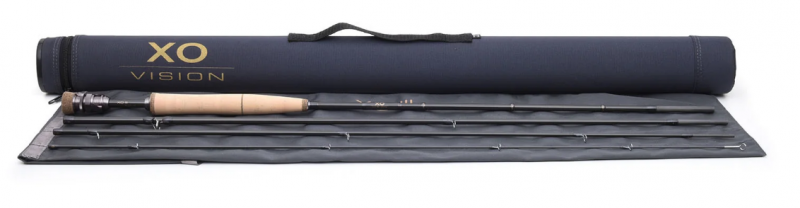
One rod that continually impresses us is the Vision XO.
It manages something quite unusual.
It feels forgiving without feeling slow.
It generates impressive line speed without demanding perfect timing.
The rod almost seems to fire the line forwards for you while still remaining smooth and enjoyable to cast.
Is that entirely because of graphene?
Almost certainly not.
Does the graphene-enhanced resin contribute to that overall feel?
Our experience suggests it probably does.
The best way we can describe graphene is as the secret ingredient in the recipe.
It isn’t the meal itself.
It doesn’t replace the main ingredients.
But when used by talented designers, it appears capable of adding something that can be felt, even if it’s difficult to measure during an afternoon on the river.
The bottom line
Graphene hasn’t replaced carbon fibre.
Modern graphene fly rods are still carbon fibre rods.
The graphene is added in tiny quantities to the resin system that bonds everything together.
Like many advances in engineering, it isn’t about one revolutionary material transforming everything overnight. It’s about making small improvements across many areas that combine to create a better finished product.
Ultimately, the only test that really matters is the one performed on the water.
If a rod feels balanced in your hand, loads smoothly, recovers crisply and gives you confidence with a fly line, then the designers have succeeded.
Whether the resin contains graphene, silica nanoparticles or another advanced additive is simply one part of a much bigger engineering picture.
At Peaks Fly Fishing, we think that’s exactly how graphene should be viewed – not as marketing witchcraft, but as a clever ingredient that, when combined with excellent design, can help create a genuinely enjoyable fly rod.